


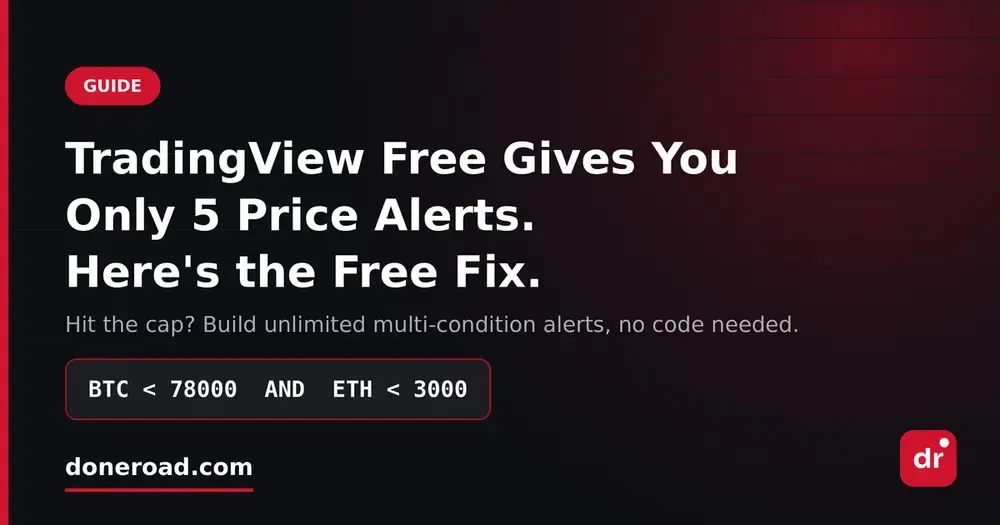
If you trade on TradingView's free Basic plan, you've probably already hit the wall: five active price alerts, and one technical alert. For anyone watching more than a couple of assets, that runs out in an afternoon.
Why five is never enough
Say you're tracking Bitcoin, Ethereum, gold and EUR/USD. That's four assets — and each one realistically needs two levels, an upside break and a downside support. Eight alerts. You're already over the cap with nothing left for the trade you actually want to take. Traders usually respond one of three ways: delete old alerts constantly, upgrade to a paid tier, or just stop using alerts and go back to refreshing the chart every twenty minutes. None of those is a great outcome.
The problem isn't the count. It's the shape of the alerts.
Most alert tools only let you say one thing: price crosses X. That's why you need so many. A single-level alert fires on a wick, fires overnight while you're asleep, and fires when nothing meaningful has changed. You end up with lots of alerts and very little signal.
What actually reduces the number you need is letting one alert express a whole scenario. Two operators do most of the work:
OR collapses a range into one rule. Instead of two alerts bracketing a range, you write: BTC > 84000 OR BTC < 78000. One rule, both sides of the range covered, fires the moment price leaves the box you care about.
AND filters out noise. A single asset moving is often nothing. The market moving is something. BTC < 78000 AND ETH < 3000 stays quiet through a Bitcoin-only dip and only reaches you when the move is broad. This is the rule that turns alerts from an annoyance back into information.
Applied across a watchlist, this typically takes 15–20 single-level alerts down to 5–6 scenario alerts — which are also the only ones you'll actually react to.
Doing it without paying
DoneRoad is a free, no-code alert builder for crypto, stocks, forex, precious metals and oil. You pick your assets, combine conditions with AND/OR, and it shows you a plain-English preview of exactly when the alert will fire before you save it. Alerts arrive on Telegram or email. There's no alert cap, no card required, and nothing to install — it's free while in beta.
Three rules worth copying to start with:
BTC > 84000 OR BTC < 78000— range break, both directions, one alert.BTC < 78000 AND ETH < 3000— broad market pullback, filters out single-coin noise.XAU > 2650 AND EURUSD < 1.05— the classic risk-off pairing.
Set them once and stop watching the chart. Build your first alert free →