


What is a multi-condition crypto price alert?
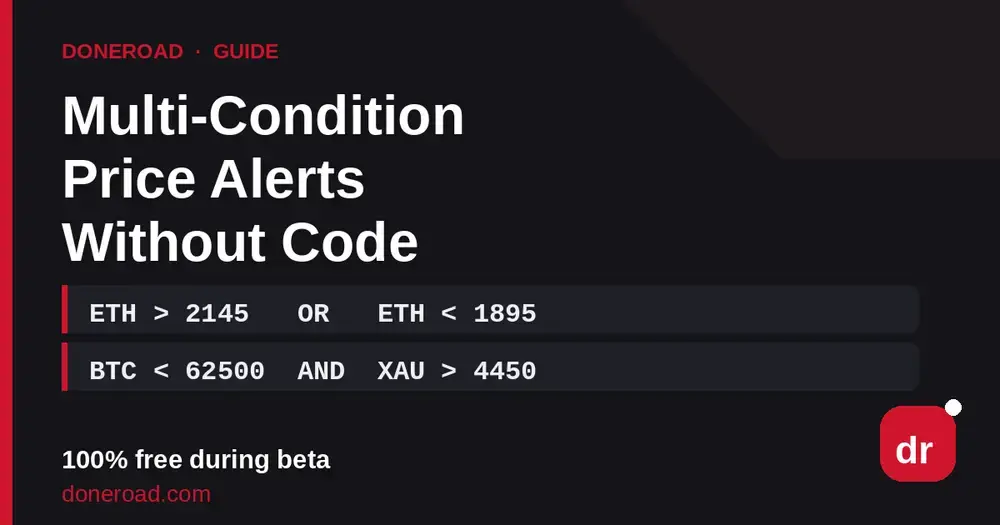
A multi-condition crypto price alert is a single alert rule that combines two or more conditions with AND or OR, such as "BTC above 67,000 AND up at least 2% in the last hour". It fires only when the combination is true, so one notification carries more meaning than a single-price alert that reacts to every touch of a level.
Most exchange alerts follow the same pattern: one asset, one price, one direction. BTC hits a number and your phone buzzes. That works until you notice that the decisions you care about usually depend on more than one thing being true, such as a level breaking and the move having momentum behind it.
Why do single-price crypto alerts fall short?
Single-price crypto alerts fall short for two reasons. They cannot tell a meaningful break from a brief wick, so they fire too often around busy levels. And traders tend to set only the level they are hoping for, so the alerts confirm good news and stay silent when the trade is going wrong.
Say ETH is capped by a resistance level near 2,140 with support near 1,900. A single alert at 2,140 tells you price touched a number. It does not tell you whether the touch means anything, and if you are long you probably never set the 1,900 alert at all. Your alerts become a confirmation machine.
How do AND and OR work in a crypto price alert?
In a DoneRoad crypto price alert, AND means every condition must hold at the same one-minute check, and OR means any single condition is enough. Use OR for coverage, such as catching whichever side of a range breaks first. Use AND for confirmation, such as a price level plus a minimum move within a time window.
| Logic | Example rule | Fires when | Use it for |
|---|---|---|---|
| OR | ETH > 2,145 OR ETH < 1,895 |
Either side of the range breaks | Two-sided levels, so the breakdown is reported as fast as the breakout |
| AND | BTC > 67,000 AND 1H change ≥ +2% |
BTC is above 67,000 and at least 2% higher than an hour ago | Filtering out slow drifts and brief pokes through a level |
| AND | BTC < 62,500 AND 15M change ≤ -1.5% |
BTC is below 62,500 and falling fast | Separating a sharp breakdown from a slow grind lower |
| OR | SOL drops 6% within 4 hours OR SOL < 120 |
A sharp drop or a hard floor, whichever comes first | Risk alerts where either signal means "check your exposure" |
All levels here are illustrations. The builder groups conditions with AND/OR and shows the result as a plain-English sentence before you save, which is where compound logic mistakes are easiest to catch.
Which condition types can a multi-condition alert combine?
A DoneRoad multi-condition alert can combine fixed thresholds, time-window changes and moving averages. Fixed thresholds compare the live value with a number. Change conditions compare it with the value 5 minutes, 15 minutes, 30 minutes, 1 hour, 4 hours or 1 day earlier, in percent or in units. Moving averages include SMA and EMA lengths from 9 to 200.
| Condition | Means | Example |
|---|---|---|
> / < |
Strictly above or below a number | BTC above 60,000 fires from 60,001 |
>= / <= |
At or above, at or below | ETH at or below 2,000 fires at exactly 2,000 |
| increase / decrease | Rose or fell by at least X% within a window | BTC rises 5% within 15 minutes |
| increase / decrease by at least | Rose or fell by at least X units within a window | Volume rises by at least 50,000 within 30 minutes |
| Moving average | SMA or EMA value against a threshold | EMA 50 above 3,000 |
Two details matter when you combine these. First, there is no "equals" operator: a price sampled once a minute rarely lands exactly on a round number, so an equals rule would never fire. Second, a change condition must have a time window, and percentage conditions need a positive number (5 means 5%). The alert FAQ covers every operator with worked numbers.
Which multi-condition crypto alerts are worth setting today?
Three multi-condition crypto alerts are worth setting first: a two-sided OR on your largest position, an AND rule that pairs a key level with momentum so you only hear about decisive moves, and a percentage-drop rule with no fixed level for sudden risk-off moves. Together they cover the breakout, the breakdown and the surprise.
- Two-sided OR on your largest position. The level where you would add, OR the level where your idea is wrong.
- A level plus momentum with AND. For example
ETH > 2,145 AND 1H change ≥ +2%, so a slow drift through resistance does not wake you. - A time-window drop. For example
BTC drops 5% within 1 day. No level to guess, and it catches moves that start far from your lines.
Each DoneRoad alert is built on one asset. If you want these rules on BTC and ETH, create them as separate alerts; they can all deliver to the same Telegram chat. The Ethereum version of the band setup is in our Ethereum price alert on Telegram guide.
Can one alert watch several assets at once?
No. Each DoneRoad alert watches exactly one asset, and AND/OR combines conditions on that same asset, such as a price level plus a percentage move. To follow several assets, create one alert per asset and route them all to the same channel, such as one Telegram chat, so every notification lands in one place.
For example, to watch Bitcoin and gold, save BTC < 62,000 OR BTC > 67,000 as one alert and XAU < 4300 OR XAU > 4700 as a second, and send both to your Telegram chat. The levels are illustrations.
Do you need code for multi-condition crypto alerts?
You do not need code for multi-condition crypto alerts. Historically they meant writing a TradingView Pine Script, wiring up a webhook, or running a Python script on a server you maintain. DoneRoad does the same job with a visual builder: pick the asset, chain conditions with AND/OR, read the preview, and choose a delivery channel.
DoneRoad checks every asset once a minute and delivers to Telegram, Discord, browser push or email. It is free during beta with unlimited alerts. If you are comparing it with TradingView's free plan, see TradingView free plan alert limits in 2026. For price sources and refresh cadence, see the methodology page.
Can a price alert use a moving average instead of a price level?
Yes. A DoneRoad alert can watch a moving average on the asset — you choose SMA or EMA and its length, then compare it to a number you enter. Combined with a price or percent-change condition on the same asset, it separates a slow drift from a fast move.
A price level answers where. A moving average answers what the recent trend looks like at that moment. Alerts that use only the first will fire identically whether the asset drifted into your level over three days or collapsed into it in twenty minutes — and those two situations rarely call for the same reaction.
Example moving-average rules
| Rule (one asset, example numbers) | What it catches |
|---|---|
| SOL EMA 20 below 215 AND SOL down 4% in 1 hour | Short-term trend already rolled over, and today is moving fast |
| BTC SMA 50 above 102,000 OR BTC up 5% in 1 day | The slower average crossed your line, or price jumped without it |
| XAUUSD EMA 20 above 4,150 | A single quiet trend condition, no noise from intraday wicks |
One important limit: the condition compares the moving average to a number you type in. It does not compare price to its own average — if you need a "price crosses its EMA" cross, DoneRoad is not the tool for that. Also, one alert watches one asset; AND / OR stacks conditions on that same asset, so three assets means three alerts, all sent to the same Telegram chat. See price alert vs stop-loss for when a notification should become an order instead, and TradingView free plan alert limits if you're hitting a cap elsewhere.
FAQ
These are short answers to common questions about multi-condition crypto price alerts, covering how AND is evaluated, how many conditions fit in a rule, which time windows are supported and whether rules can span several coins. Each answer describes DoneRoad as it runs today; the alert FAQ has worked examples for every operator.
Does AND mean the conditions must be true at the same time?
Yes. With AND, every condition must hold at the same one-minute check. Two conditions that were each true at different moments do not fire an AND rule.
Which time windows can a change condition use?
Change conditions support 5 minutes, 15 minutes, 30 minutes, 1 hour, 4 hours and 1 day. A change condition without a window never fires.
Can one alert combine conditions on BTC and ETH?
No. Each DoneRoad alert watches one asset. Create one alert per coin and send them to the same channel.
Why didn't my EMA 200 condition fire on a newly added asset?
Moving averages need enough one-minute history. Until 200 readings exist, an EMA 200 condition does not hold, rather than firing on a partial average.
Which moving averages can I use in an alert?
Both SMA and EMA, with a length you choose. The condition compares that average against a number you enter (for example "EMA 20 below 215"), and it can be combined with price-level or percent-change conditions on the same asset using AND / OR. Prices are read once a minute, so a spike inside a single minute can be missed.