


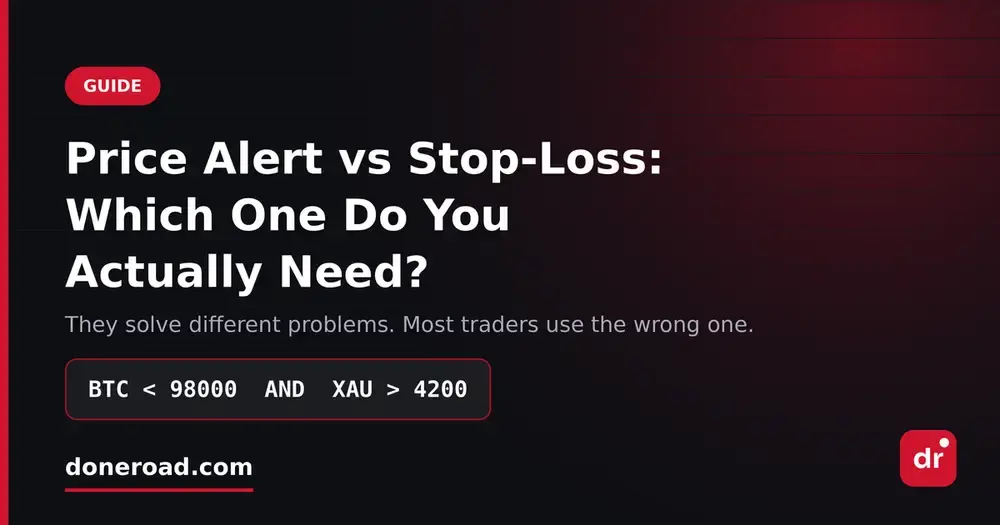
Most traders treat "stop-loss" and "price alert" as two names for the same safety net. They aren't. One acts for you; the other informs you. Picking the wrong one is how people end up stopped out of a position they wanted to keep — or how they sleep through the entry they'd been waiting two weeks for.
What a stop-loss actually does
A stop-loss is a live order resting on the exchange or with your broker. When price touches your level, it fires. No confirmation, no context, no second look at the chart. That automation is the entire point: it removes you, and your emotions, from a decision you already made calmly in advance.
The trade-offs are real, though. A stop-loss only works on a position you already hold. It only understands one instrument — the one it's attached to. And in a thin or volatile market, a wick can take you out at a price you never intended before the candle closes back where it started.
What a price alert actually does
An alert changes nothing about your portfolio. It watches a condition and, when that condition becomes true, it tells you — via Telegram, email, push. Then it stops. Whatever happens next is your call.
That sounds weaker. In practice it covers a much wider set of situations, because you can set an alert on something you don't own, on several markets at once, and on conditions no exchange order type can express.
When the alert is the right tool
- You're waiting to enter, not to protect. You want to buy BTC if it drops under $98,000. A stop-loss can't help you here; there's no position yet.
- The condition spans more than one market. "BTC below $98,000 AND gold above $4,200" says something neither leg says alone — risk-off is real, not just a crypto wobble. No single exchange knows both numbers.
- You want judgement in the loop. Price hitting a level is information, not a decision. Sometimes the right response is to buy, sometimes to wait for the daily close, sometimes to do nothing.
- You can't watch the screen. Overnight moves, the workday, a flight. The alert is the thing that wakes you up.
When the stop-loss is the right tool
If you're already in a trade, you've defined your invalidation level, and you know you won't act fast enough manually — use a stop. Judgement is exactly what you don't want at 3am in a fast market. Don't replace a stop with an alert and call it risk management; an alert you sleep through protects nothing.
Most traders need both
Stops on open positions. Alerts on everything you're waiting for. They cover different halves of the job: the stop handles the trade you're in, the alert handles the trade you haven't taken yet.
Setting up the alert side in about a minute
DoneRoad is a free, no-code tool for exactly that half. You write the rule in plain English, combine conditions with AND/OR across crypto, stocks, forex, precious metals and oil, and check the plain-English preview before saving. When the rule is true, it pings your Telegram or email. It never places a trade for you — that part stays yours.
Try it free at doneroad.com.