


What is price alert fatigue?
Alert fatigue is what happens when so many price alerts fire that you stop reading them. The notifications still arrive, but they no longer carry information, so you swipe them away — including the one that mattered. It is caused by how the alerts are built, not by a lack of discipline.
Why does lowering the price level make it worse?
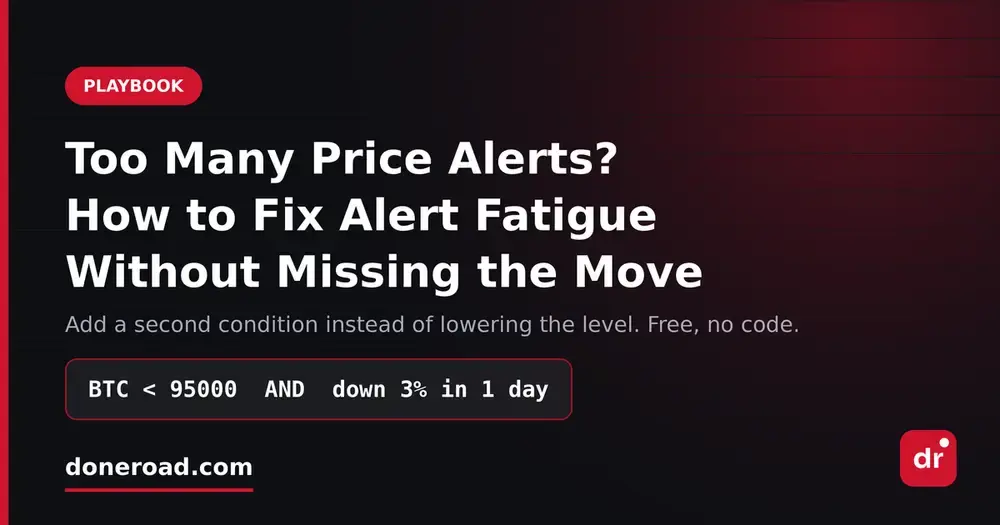
When an alert feels late, the instinct is to move the level closer to the current price. That makes it fire sooner, but it also makes it fire on every small wobble around that number. You get more notifications and less signal. The better move is to keep the level where it is and add a second condition that the move has to satisfy.
How do you add a second condition instead?
One DoneRoad alert watches one asset, and AND/OR stacks conditions on that same asset. That lets you describe not just where the price is, but how it got there. All levels below are illustrative examples, not current prices.
| Problem | Noisy rule | Quieter rule, same coverage |
|---|---|---|
| BTC chopping around a level | BTC price below 95,000 | BTC price below 95,000 AND down 3% in 1 day |
| Gold could break either way | Two separate alerts | XAU/USD above 4,250 OR below 4,050 (one alert) |
| A stock drifting down slowly | AAPL below 230 | AAPL below 230 AND down 2% in 1 day |
| A pair you only care about on momentum | EUR/USD above 1.1850 | EUR/USD above 1.1850 AND up 0.5% in 4 hours |
Available condition types
Price level, % or unit change over a window from 5 minutes to 1 day, SMA/EMA compared to a number you enter, and volume. Note what SMA/EMA does here: it compares the moving average itself to a number you type in, such as “EMA 20 below 215”. It is not a price-crossing-its-average condition.
How should you split alerts across channels?
Urgency should be visible before you open the notification. Send rules you would act on within minutes to Telegram or browser push. Send rules that are only context — a slow level being reached, a weekly range edge — to email, where they sit until you read them. If everything lands in the same place with the same sound, your brain stops ranking them and starts ignoring all of them equally.
How many alerts is too many?
There is no magic number, but there is a useful test: if an alert fires and you do nothing, that alert was wrong. Either tighten it with a second condition or move it to email. Run that audit once a month and the list stays short on its own.
Two limits worth knowing
One alert watches one asset — covering BTC, gold and AAPL means three separate alerts, all of which can send to the same Telegram chat. And prices are checked once a minute, so a spike that appears and reverses inside a single minute can be missed.
FAQ
Does adding a second condition mean I’ll miss moves?
It means you’ll miss the moves that did not meet your own definition of significant. If you want full coverage of a level plus a tighter urgent rule, build two alerts on the same asset and send them to different channels.
Can I put several assets in one alert to reduce the count?
No. One alert watches one asset. Stacking conditions with AND/OR works on that same asset only. Several assets means several alerts, which can all deliver to the same Telegram chat.
What’s the fastest way to clean up an existing alert list?
Delete anything that fired this month without changing what you did. For the rest, see our guides on multi-condition alerts and price alerts vs stop-loss orders.
Is this different from TradingView’s alert limits?
Different problem. That one is about how many alerts you’re allowed to keep running — see TradingView free plan alert limits. Alert fatigue is about how many of them are worth reading.
Free while we’re in beta, no code required. Set up your first rule.