


How do you set price alerts before a Fed meeting?
To set price alerts before a Fed meeting, choose the markets the decision could move, write down one confirmation level and one invalidation level for each, and join the two levels with OR in one alert per market. DoneRoad, a free no-code alert app, then checks prices every minute and messages you on Telegram, Discord, push or email.
Every trader has lived this week. A Fed decision is on the calendar, the market goes quiet for days, and you refresh the chart every twenty minutes for a move that has not happened yet. When it finally happens, you are asleep, in a meeting, or too rattled to follow the plan you had. The fix is not more discipline. It is doing your thinking on the quiet days and letting an alert do the watching.
When do Fed announcements move prices?
The Federal Open Market Committee (FOMC) holds eight scheduled meetings a year. The policy statement is released at 2:00 p.m. Eastern Time on the final day, followed by the Fed Chair's press conference at 2:30 p.m. Four meetings a year also publish economic projections. Minutes follow about three weeks after each meeting.
| Fed event | What is released | Typical timing |
|---|---|---|
| Policy statement | Rate decision and statement text | 2:00 p.m. ET on the last day of the meeting |
| Press conference | Chair's remarks and Q&A | 2:30 p.m. ET, the same day |
| Summary of Economic Projections | Rate, growth and inflation projections, including the "dot plot" | With the statement at four of the eight meetings |
| Meeting minutes | Detailed record of the discussion | About three weeks after the meeting |
Check the Federal Reserve's own calendar for the actual dates. The first move after the statement can reverse during the press conference, which is why the alert rules below are built to tell you which scenario is playing out rather than to react to the first candle.
Which levels should you set before a Fed decision?
Before a Fed decision, set exactly two levels per market: the price that confirms the move you expect and the price that proves your view wrong. Two levels, not five. Choose them on a quiet day from the chart, because a level picked thirty seconds after a red candle usually comes from fear, not analysis.
If you cannot name both levels, you do not have a thesis yet. Write the action next to each one ("gold below 4,500: reduce the position") so the alert arrives with a decision already attached. For more on why an alert and a stop-loss are different tools, see price alert vs stop-loss.
How do you cover both hawkish and dovish outcomes?
Cover both Fed outcomes by joining the hawkish and dovish levels with OR in one DoneRoad alert per market, and sending every alert to the same Telegram chat. Each alert fires on whichever of its levels breaks first, so the alert that arrives tells you which scenario is playing out, with no chart to watch.
Fed outcomes are often framed as mirror images: a hawkish surprise tends to support the dollar and weigh on gold and risk assets, and a dovish one tends to do the opposite. That is not always how markets react, but it is a useful way to plan. For each market, write one two-sided or one-sided rule, for example a gold alert and a separate Bitcoin alert:
XAU < 4500 OR XAU > 4700
BTC < 75000
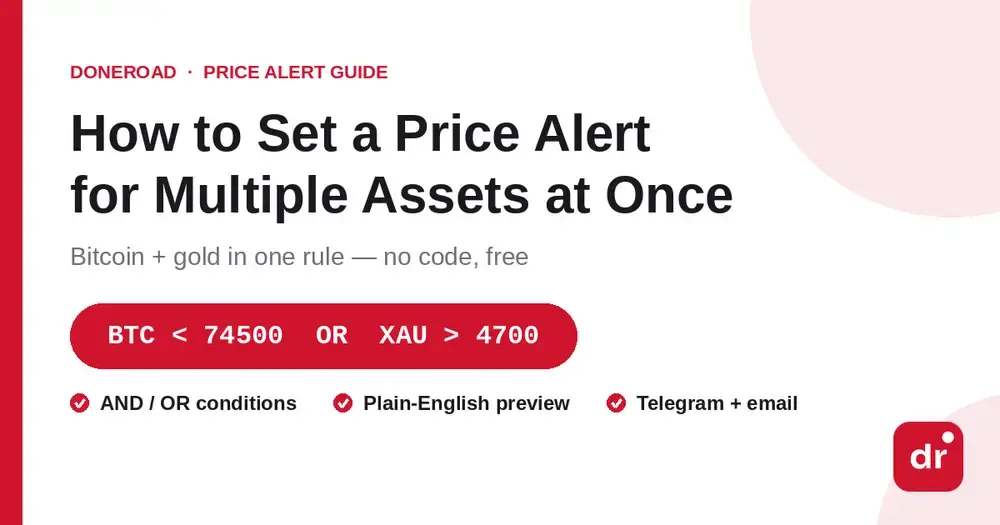
The levels are illustrative; use your own. If the gold upside leg fires, the market is leaning dovish. If the gold downside leg or the Bitcoin alert fires, it is leaning hawkish. Both alerts go to the same chat, so the notification is not only noise reduction, it is information. For what AND and OR can do inside one alert, see how multi-condition alerts work.
How do you filter out Fed-day fakeouts?
Filter out Fed-day fakeouts by adding a confirming condition with AND instead of loosening your level. DoneRoad's AND requires every condition to hold at the same moment, so a wick that sweeps your level alone will not fire the alert unless a second condition on the same asset, such as a percentage move, agrees with it.
Two ways to confirm:
- Daily-move confirmation.
XAU < 4500 ANDgold down at least 2% within 1 day fires only if the break is part of a real post-decision sell-off, not a brief sweep of the level. - Momentum confirmation.
XAU < 4500 ANDgold down at least 1% within 1 hour fires only if the break came with a real move, not a slow drift.
To see whether the dollar agrees, set a separate EUR/USD alert, such as EURUSD < 1.14, and send it to the same chat as your gold alert.
Which alert conditions work best around a Fed meeting?
Around a Fed meeting, the most useful DoneRoad conditions are a two-sided OR fence, a percentage move within a short window, and an AND rule that needs confirmation. Percentage-change conditions accept windows of 5 minutes, 15 minutes, 30 minutes, 1 hour, 4 hours or 1 day. The examples below use illustrative levels.
| Condition type | Example | When it fires |
|---|---|---|
| Two-sided fence (OR) | XAU < 4500 OR XAU > 4700 | Gold leaves the pre-meeting range either way |
| Fast move | BTC drops 3% within 15 minutes | Bitcoin is at least 3% below its price 15 minutes earlier |
| Volatility either way | XAU rises 1% within 30 minutes OR falls 1% within 30 minutes | Gold moves sharply in either direction after the statement |
| Confirmed break (AND) | XAU < 4500 AND gold down 1% within 1 hour | Both conditions on gold hold on the same reading |
A 1-day window is useful when you care about the whole reaction, not only the first minutes. How each condition compares prices is explained step by step in the alert conditions guide.
Where should a Fed-week alert be delivered?
A Fed-week alert should go to a channel that makes your phone buzz, such as Telegram, Discord or browser push, with email as a backup record. An email you read the next morning is not an alert. The value of the rule is shrinking the gap between "the level broke" and "you know it broke."
DoneRoad reads prices once a minute, so a spike that starts and reverses inside a single minute is not captured. Delivery after that depends on the channel's own service. Prices come from third-party sources and are passed on as received; the methodology page lists each source.
Then stop looking. Once the rule is set, the right behaviour for the next few days is to do something else. You have already made every decision that matters, and sitting in front of the chart can only add bad ones.
FAQ
Common questions about Fed-meeting price alerts cover timing, watching several markets, repeat notifications and trading. In short, set DoneRoad alerts on a quiet day before the FOMC decision, use one alert per market sent to the same channel, and remember that DoneRoad sends notifications only and never places trades.
How far ahead of an FOMC meeting should I set alerts?
Set them on a quiet day before the meeting, once you have chosen your levels from the chart. There is no benefit to waiting until the statement is out.
Can one alert watch gold and Bitcoin for the Fed decision?
No. Each DoneRoad alert watches one asset. Set one alert on gold and one on Bitcoin, and send both to the same Telegram chat so they arrive side by side when the decision lands.
Will the alert keep firing if the price stays past my level?
No. DoneRoad applies frequency limits so the same alert does not keep repeating, and every trigger is logged for 30 days.
Does DoneRoad place trades when the Fed alert fires?
No. DoneRoad only sends notifications. It never places orders or holds funds, and an alert is not financial advice.
Set your Fed-week rules on a quiet day: create a free DoneRoad account.